|
Assumptions
of Mendelian Inheritance
- Constant
environment (temperature, nutrition, sunlight etc.)
- Traits
only influenced by known gene loci
- Genes
assort independently -- zero "linkage"
Mendelian inheritance
Use Flowers
tutorial: p:\data\biology\biol14\tutorial\flowers.exe
Know
these terms:
- Gene Locus
- Gene Product
- Allele
- Dominant and Recessive alleles; Null alleles
- Trait
- Genotype
- Phenotype
- Hybrid: Monohybrid; Dihybrid -- Dihybrid Cross -- Dihybrid
Cross (local copy)
- Self cross
- Test cross or Back cross (when are these the same -- and
when not?)
- Probability rules
Problems:
Mendelian Genetics
Practice from a course at MIT.
Virtual Fly : Breed
your own fruit flies.
Other links:
Horse Genetics: describes interesting horse
phenotypes and genotypes, crosses and results
Online Mendelian Inheritance in Man: a
professional physician’s reference on inherited diseases
Alleles: What are they?
An allele
is a particular version of a given DNA sequence. "Allele" is a
relative term, implying more than one possible version or copy, like
different editions of a book. Like editions of a book, all
existing alleles result from a process of change, either gradual or
drastic change.
Examples:
Allele 1
ATCGTTAGATTACAGATTTACCGA
TAGCAATCTAATGTCTAAATCCGT
Allele 2
ATCGTTAGATTCCAGATTTACCGA
TAGCAATCTAAGGTCTAAATCCGT
Allele 3
ATCGTTAGTGTAATGATTTACCGA
TAGCAATCACATTACTAAATCCGT
Allele 4
ATCGTTAG-GATTTACCGA
TAGCAATC-CTAAATCCGT
Notice
that there can be more than two possible alleles for a given
gene locus (but only two at a time, in a given diploid individual.)
Multiple alleles can mean many
different possible combinations for individuals. An example of
multiple alleles is human blood type -- A or B alleles encode a blood
serum protein, whereas the O allele makes no protein ( a null
allele.) Gene loci which confer traits of tissue type may have 20
or more different alleles.
Natural
and "artificial" alleles
- Natural
alleles result from evolution, the process of natural selection.
- Artificial
alleles can be created by molecular genetics.
- Both
natural and artificial alleles can be used by the scientist for
breeding purposes.
Alleles can be observed as DNA polymorphisms,
using restriction digest and gel electrophoresis (see Week 7).
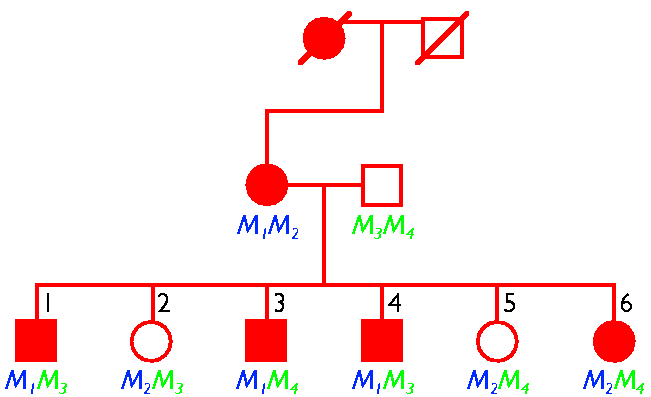
An allele may be linked to an inherited
disease--a clue as to the gene locus defective in the disease.
Which of the four alleles (M1-M4) is linked
to this disease?
Is the disease likely to be dominant or recessive?
For
a Kenyon student's report on an inherited disease in her family, see Tuberous
Sclerosis Complex.
Alleles confer traits, by expressing
gene products, which are either mRNA and protein, or a functional
RNA. But how they determine a "visible trait"
is not simple. Consider this:
Problem:
Fruit fly eyes have two pigments,
brown and scarlet. Normal flies make
both pigments, but a
strain with defective gene B has brown eyes, and a
strain with defective
gene S has scarlet eyes.
In the wild type, WHICH
GENE (B or S) makes which pigment (brown or scarlet)?Solution
In
practice, the most common "new" alleles (arising out of mutation) are
often named for a phenotype resulting from the absence of their gene
product. Thus the allele for a gene producing scarlet pigment is
named "brown" for the brown eye in the absence of scarlet pigment.
Consider
albinism, or loss of pigmentation, a very common phenotype observed in
many species of animals and plants. Alleles can confer loss of
pigmentation in two different ways:
- Recessive
albinism. The allele encodes an enzyme which converts pigment
precursors into dark pigment; or a protein required for pigment
deposition. (Humans; mice; penguins.)
- Dominant
color suppression. The allele encodes a regulatory protein
which represses synthesis or deposition of pigment. (Horse;
foxglove)
Traits
are not actually inherited like "beads on a string." Traits result from
complex interactions (1) among the products of genes; (2) between genes
and regulatory proteins expressed by other genes; (3) between genes and
proteins, and environmental factors such as nutrients, temperature,
etc.; (4) chance effects during development.
The
reason Mendelian inheritance can be seen to "work" is that in many
cases we can hold all the above factors constant, for a given genotype
(genes affecting a trait) and a given phenotype (appearance of
trait).
Other ways alleles can work (still at a SINGLE
gene locus)
- Codominance
or incomplete dominance. Codominant alleles each contribute
to the phenotype; for example A and B blood type alleles together
produce AB blood type. Incomplete dominance means that the
hybrid produces a lesser degree of the dominant phenotype than the
purebreeding dominant.
- Lethality.
If an allele (either dominant or recessive) results in death before
birth, a class of progeny will be absent from the offspring. What
ratios will result?
Pleiotropy. One allele (or pair of
recessive alleles) at one gene locus can result in many diverse effects
throughout the body.
Artificial
alleles. Today we can use molecular genetics to create artificial
alleles in transgenic animals and plants. There are two
ways to make a transgene, which
have different consequences for inheritance:
- Allele
insertion. Inject or transfect DNA into a fertilized
egg. The DNA sequence gets taken up somewhere in the genome, but not
at the same position as any homologous gene. The
position on the gene map is unpredictable (but fixed once the allele is
inserted.)
- Allele
replacement. A DNA sequence containing a linked selective
marker (such as drug resistance) is put into embryonic stem cell
culture (ES cells). The ES cells are put into a blastula, which
develops into a chimeric offspring; eventually a pure-breeding line is
bred. In this case, the new allele recombines homologously
and replaces an allele at a standard map position.
Dihybrid Cross -- or local link.
Advanced
Problem. Explain how to breed transgenic mice to create a mouse
model for sickle-cell anemia.
Sickle Cell Anemia.
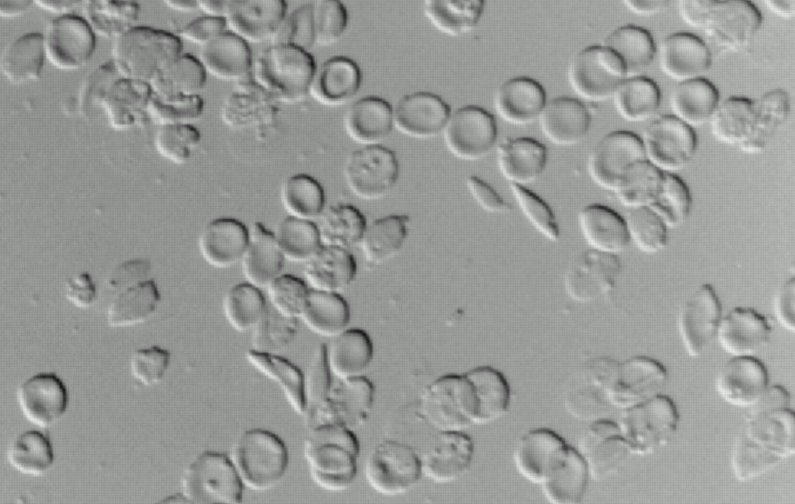
Pászty et al, Science 1997 October 31; 278: 876-878.
Sickle-cell
disease is caused by a single base pair defect in human beta-globin.
- Double-recessive
genotype--red blood cells sickel under stress.
- Single-recessive
heterozygote--cells sickle only when attacked by malaria
parasites. Prevents malaria.
To
test drug therapies for sickle disease, can we generate a transgenic
mouse model for human sickle-cell anemia?
For
the model strain to exhibit sickle-cell pathology, the native mouse
genes--all at separate loci--must be defective (null alleles.) We
have a transgenic mouse strain,
containing human Hb-alpha, Hb-beta-sickle
on a transgene,Tg(Hu), inserted
somewhere in the mouse genome (not at the mouse globin genes.)
But the mouse still has its own genes producingalpha
and beta globin.
To
construct this strain, the transgenic strain was intercrossed with a
mouse strain heterozygous for null alleles
for alpha and beta globin.
Tg(Hu) Mouse-alpha-Hb
Mouse-beta-Hb
--------
----------------------
----------------------
Tg(Hu) Mouse-alpha-Hb Mouse-beta-Hb
X
-- Mouse-alpha-Hb Mouse-beta-Hb
--------
--------------------
--------------------
-- ----
----
How
many generations would you need to cross?
What proportion of mice would show the desired
phenotype of blood with entirely human globins?
Tg(Hu)
----
----
------------
------------------ -------------------
Tg(Hu)
----
----
What
would the researchers have to do to create a similar model with
exclusively normal human blood? Why would this be important in
order to use the model? (For further interest, read Ryan et
al, 1997.)
|
 KAP
KAP