Eukaryotic
RNA polymerases; in vitro transcription
Enhancer
Elements on DNA
Transcription
Factors and Transcriptional Activation
Post-transcriptional
Control
Advanced
Topic: Research on the Gridlock Transcription Factor
Eukaryotic
Gene Control
Eukaryotic control sites
include promoter consensus sequences similar to those in bacteria.
However, there can be many
control sequences, called enhancers and silencers, responsive to many different
signals. Enhancers were defined by cis/trans complementation experiments,
in which their activation only occurred when they were present on the same
DNA helix with the gene under their control. Thus they were originally
called cis-acting elements; this terminology is still used in experiments
defining new regulatory sites.
Three RNA Polymerases
in Eukaryotes
Review from before break:
Eukaryotes have three different RNA polymerases, which transcribe three
different classes of genes. RNA pol II transcribes hnRNA (precursor
to mRNA). RNA pol I and III transcribe functional RNAs such as rRNAs
and tRNAs.
Initiation of RNA pol
II transcription requires multiple basal transcription factors.
Most of these were identified initially through biochemical approaches,
i.e. fractionation of nuclear extracts (by chromatography or density gradient
centrifugation) and reconsitution of transcription in vitro.
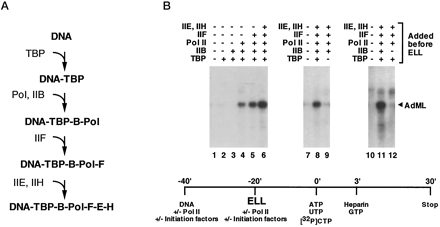
For example, in this experiment,
different purified basal transcription factors (TBP, TFIIB, IIF, IIE, IIH)
and RNA polymerase II were mixed and matched to see which would support
transcription from the adenovirus major late promoter.
(Shilatifard
A, Haque D, Conaway RC, Conaway JW. J Biol Chem 1997 Aug 29;272(35):22355-63)
Discovery
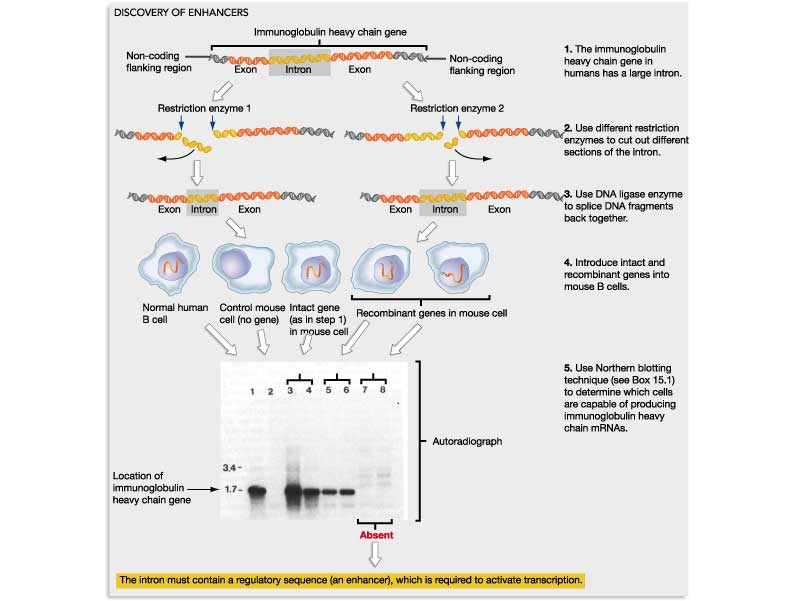
of Enhancers: Using recombinant DNA transfected into cultured
cells.
Susumu Tonegawa: Transcription
of the human antibody heavy chain gene is under control of enhancer elements
in Intron 1.
[Figure from Freeman,
S. (2002) Biological Science]
Assessment
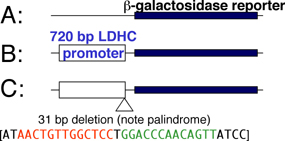
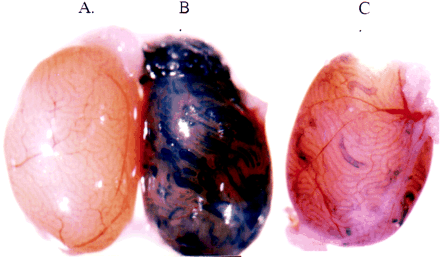
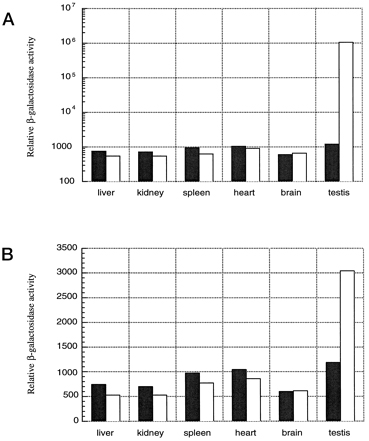
of enhancer elements using recombinant reporter genes in transgenic
mice:
Testis-specific Lactate Dehydrogenase C promoter.
How
do enhancer elements work to regulate transcription of specific genes
in specific times and places? By
serving as binding sites for transcription factors--proteins that regulate
transcription.
[Figure from Freeman,
S. (2002) Biological Science]
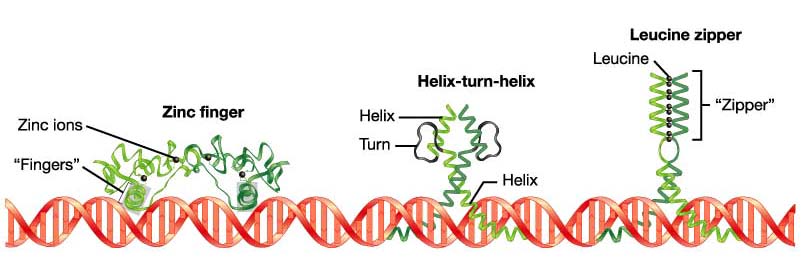
DNA:Protein and Protein:Protein
interactions are important for transcription factor function.
Note modular structure of transcription factors: one part of the
protein is responsible for DNA binding, another for dimer formation, another
for transcriptional activation (i.e. interaction with basal transcription
machinery).
Dimer formation adds an extra
element of complexity and versatility. Mixing and matching of proteins
into different heterodimers and homodimers means that three distinct complexes
can be formed from two proteins.
[Figure from Freeman,
S. (2002) Biological Science]
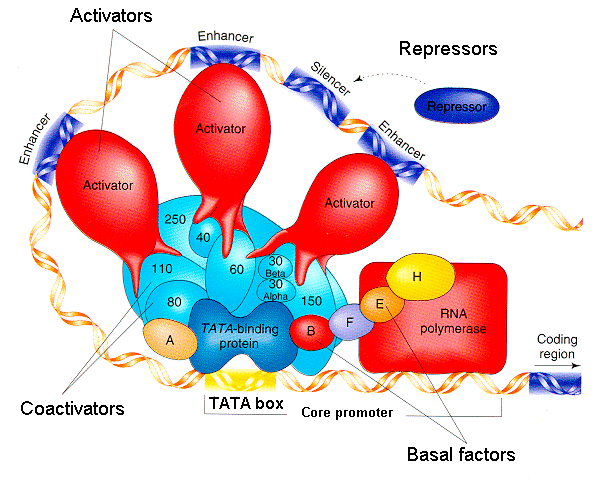
A COMPREHENSIVE MODEL
OF REGULATION OF RNA POLYMERASE II TRANSCRIPTION:
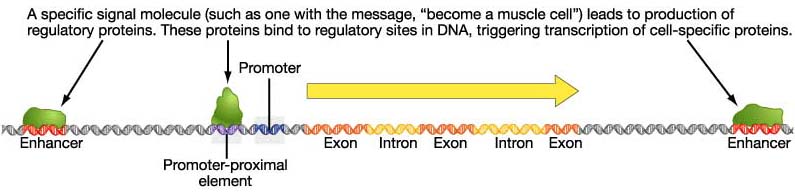
Although they are cis-acting,
the enhancers and silencers can be strung out across 10-20 kilobases (thousands
of base pairs) of DNA upstream. Some signals can even be downstream
of the coding gene, or even found within introns (!) How can
this be possible? Long regions of the DNA can loop over to enable
the regulatory connections.
Based on Robert Tjian, "Molecular
Machines that Control Genes," Scientific American.
-
Activators bind to enhancer
sites, controlled by hormones or other signals. They increase transcription
of the regulated gene.
-
Repressors bind to silencer
sites, controlled by hormones or other signals. They decrease transcription
of the regulated gene, possibly by interfering with activators.
-
Coactivators bind to activators
and/or repressors (at one end) and to basal factors (at the other
end). The coactivators somehow communicate the signal from activators
and/or repressors to the RNA polymerase.
-
Basal factors act similarly
to bacterial sigma factors. They enable RNA polymerase to initiate
transcription. However, they require interaction with coactivators.
How were all these
control proteins figured out? Robert Tjian explains some experiments:
-
The researchers tested human
cell extracts for a sigma-like protein: one that (1) bound to DNA and (2)
stimulated RNA transcription in the test tube. They tested many,
many proteins, and found one: SP1.
-
SP1 only increased transcription
when the DNA contained "GC box" sequence (an enhancer). Without GC
box, only basal (low-level) transcription occurred.
-
The "zinc finger" domain of
SP1 was essential for binding to GC box. The "glutamine-rich domain"
was not needed for DNA binding, but was needed to increase transcription.
The researchers guessed that the glutamine-rich domain bound to basal factors
needed for low-level transcription, and converted it to high-level transcription.
-
Basal "Factor D" (known to bind
TATA box) was suspected to be the target of SP1. To Tjian's surprise,
however, when Factor D was better purified, SP1 failed to increase transcription.
Therefore he guessed that Factor D included the TATA Binding Protein plus
some other factor. The other factor(s) turned out to be eight coactivators.
RECALL. . . Splicing
of hnRNA to make mRNA
The first transcript of RNA
from a eukaryotic gene is not yet ready for transcription. It
is called hnRNA, for high-molecular-weight nuclear RNA.
In order for the RNA to exit the nucleus, and for proteins to
be translated by ribosomes in the cytoplasm, the following processing
steps must first occur:
-
Capping of the 5' sequence with
5' methyl-7-guanidine (the "m-7-G cap")
-
Addition of a run of adenine
nucleotides to the 3' OH end (the "poly-A tail")
-
Splicing out of the intron sequences
Interestingly, retroviruses
such as HIV which use an RNA genome have a "cap" and "tail," enabling them
to mimic harmless messenger RNA.
Post-transcriptional control
Degradation of mRNA.
Certain hormones can stimulate (or retard) the rate of degradation of mRNA,
thereby decreasing (or increasing) its availability fortranslation to protein.
Translational repression.Translation
of mRNA can be repressed. For example, when iron is low, in human
blood, a translational repressor protein binds to the mRNA encoding the
iron carrier protein ferritin, and prevents translation of the iron carrier.
Post-translational
control
Protein cleavage and/or
splicing. The initial polypeptide can be cut into different functional
pieces, with different patterns of cleavage occurring in different tissues.
In some cases, different pieces may be spliced together.
Chemical modification.
Protein function can be modified by addition of methyl, phosphoryl, or
glycosyl groups.
Signal sequences direct
packaging and secretion. Some proteins have "signal sequences" which
direct their packaging in the Golgi and movement through the endoplasmic
reticulum (ER) to be secreted. The signal sequences usually end up
cleaved off.
Problem.
Gene expression is subject to many levels of control. Outline the
mechanisms at all the levels of control, from gene sequence to final product.
Explain why control is useful at different levels.
Research
Advanced topic:
"Gridlock," a Developmental
Regulator in Zebrafish
Zebrafish is a major model
system for vertebrate development.
The "gridlock" gene grl
was
discovered as a major developmental signal distinguishing
between arteries and veins in the early vertebrate
embryo. (Zhong et al, 2000, Science 287:1820).
Genotype
and phenotype of grl.
-
Chemical
mutagenesis of a large population of zebrafish yielded some deformed embryos.
-
One
deformed embryo lacked circulation to the
back and tail, due to a blocked arterial junction--"gridlock".
-
By
positional
cloning (see below) the mutation was mapped
and sequenced to a gene named grl.
-
A point
substitution resulted in partial
loss of function of the gene product.
When
grl
mRNA was injected, the mutant embryo developed normal arterial circulation!
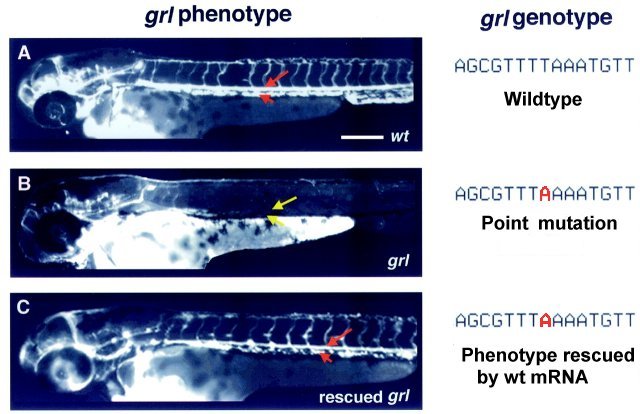
Zhong et al, 2000, Science 287:1820
How was grl mapped,
located, and sequenced?
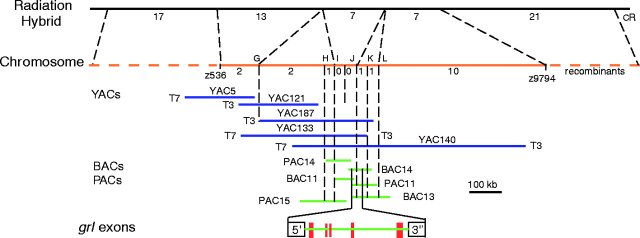
It is no small task to
find one gene in a vertebrate genome of perhaps 50,000 genes, buried within
20X as much non-coding DNA. Friday afternoon's Advanced Topic session
will present the details.
-
Classical recombinant mapping
(meiotic crossover analysis) between hybrid grl carriers and fish
with various genetic markers. These markers are sequence
polymorphisms detectable by SSLP PCR.
-
The
position of the mutation was narrowed down to ever smaller chunks of DNA
by radiation hybrid cloning, yeast artificial chromosomes (YACs), bacterial
artificial chromosomes (BACs), and P1 phage clones (PACs).
-
Bioinformatic
analysis revealed exons and introns.
BAC and PAC clones were used to screen embryonic cDNA libraries for genes
expressed during early development.
-
One
gene was found which:
-
Was
expressed ONLY in the embryonic aorta
- Contains
a point substitution of lysine instead
of a stop codon--thus the protein extends
44 extra amino acids
Zhong et al, 2000, Science 287:1820
What is the function
of grl?
Bioinformatic analysis
of the grl sequence identifies it as a transcription factor of the Helix-Loop-Helix
family. This protein motif (short conserved protein sequence) is
found in many Drosophila homeotic developmental genes (more later.)
To find out about protein families and domains, see Procite.
Click for Chimeview--Helix-Loop-Helix
Model
The terminal ends of the
protein form a clamp that binds DNA. Major or minor groove?
Check the Chime model!
The protein encoded by
grl appears to be a transcriptional repressor that distinguishes certain
populations of aortic angioblasts (precursor cells of arterial structures).
|