|
Biomorph 2 Answer Key 1. The Chief Spin Officer was fired
because you blew away their first claim. "Our advanced Biomorph genomes contain a special allele for Interspecies Cooperation, which is dominant to the recessive allele. Since the Interspecies Cooperation allele is dominant, its frequency will increase in our population, and any problems we have getting along with you will soon disappear." What do you say? Whether a trait is dominant or recessive does not directly determine its allele frequency. Either dominant or recessive traits can be selected for or against. It is not clear whether the Interspecies Cooperation allele will undergo positive selection or not. 2. In Galapagos, Akiko had especially hairy skin, a condition called hypertrichosis. Based on the description in the book, and information you find in OMIM, what genetic trait do you think she might have had and why? (Various answers possible.) Lots
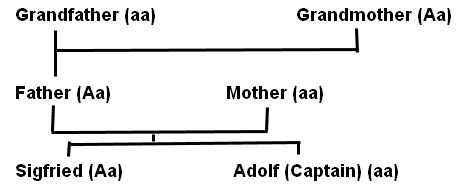
of answers possible. 3. a. From the information you can find in the text of Galapagos, draw the family tree of the captain von Kleist and his brother. Define and include an appropriate genotype designation for each person. b. Consider a hypothetical sister of Adolf and Sigfried. What are the possible genotypes for her and what chance does she have of having the disease? c. You are a genetic counselor, and you are visited by a young person whose father died of Huntington’s disease who was planning to marry someone who did not have the disease in her family. What would you advise them and why? A DNA test now exists to detect whether one carries the Huntington allele. How would this change your advice? 2a. Family von Kleist
b. A sister of Sigfried and Aldolf could be either Aa or aa, with 50% chance of either genotype. c. Without the DNA test the potential father could be Aa or aa. Therefore, he has 50% chance of getting Huntington's disease. He is marrying an aa. If he carries Huntington's, the chance is 50% that his child will get it (inherit allele A). Therefore, 0.50 x 0.50 = 0.25; 25% chance that his childe will get the disease. How to advise them? Without the DNA test, you see the above percentages, only 25% chance of having a child with the disease. Some would consider that percentage too high to chance. Some would consider it a low percentage and also consider that quality of life is good until after middle age. With the DNA test, you would know what genotype the potential father is and thus know whether there is a 50% chance of having a child with the disease or a 0% chance of having a child with the disease. How to advise them? If the potential father is a carrier (will certainly develop the disease), can they live with the fact that their child with have a 50% chance of having the disease? Is adoption a possibility? Artificial insemination? Other options… If the potential father does not have the disease, now he has no doubts about his future (with respect to the disease) and practically complete assurance that the child will not have the disease.
a. Use the Hardy-Weinberg Law to determine the allele frequency (p) for the Huntington allele. b. If you carry one copy of the Huntington allele (p), does that also mean you will develop the disease and die? 1
in 500 carry the gene. What is p, the allele frequency? 5. Researchers have identified an allele of a gene that confers resistance to HIV virus, the cause of AIDS. The allele is a version of the CCR5 gene that has part of its sequence deleted (allele CCR5-delta 32). The CCR5-delta 32 allele is present at a frequency of 0.08 in the Caucasian population of the United States. Persons who are homozygous recessive (aa) show virtually complete resistance to HIV, and those who are heterozygous (Aa) have 78% lower risk of HIV infection. Those who are homozygous dominant (AA) have no resistance to HIV. Find the percentages of the US Caucasian population that exhibit the 3 possible phenotypes.
0.08 allele frequency for the mutant gene which is recessive. 6. Explain how each of the following traits is determined by genes and/or environment: * Hearing vs. Deafness Hearing
requires proper bone formations inside the ear, as well as nerves and
sensory cells. These are determined by genes, which are inherited. Defects
in the genes can results in deafness. At the same time, hearing can
be diminished by environmental factors such as loud noise, poisons,
and aging. Spoken
language requires genes for development of the "voice box"
as well as speech processing areas of the brain. Thus, humans can speak
but chimpanzees cannot. However, the precise language that one speaks
depends entirely on the culture in which one is raised. A Chinese baby
adopted in the USA will speak perfect English, whereas a USA baby raised
in China will speak perfect Chinese. All human beings have the genetic
potential to speak all human languages (although that potential is rapidly
modified by cultural environment, from birth onward). [See opening of book for full answers, which you would need on the test.] Each scientific hypothesis is presented with evidence against it, to be considered and argued by the scientists. Each religious hypothesis, such as that Noah's ark put them there, is simply stated as such, with no evidence for or against. That is because religious beliefs are taken on faith, whereas scientific beliefs are based on material evidence. Scientific beliefs can be disproven; or they can be shown to represent reality based on a widespread consensus of evidence. 8. Suppose a human evolved the ability to absorb solar energy through photosynthesis, instead of eating food. a. What would we call the kind of evolution that generates a "plantoid" person? Would the person be able to interbreed with plants? b. How many photons would the plantoid need to absorb in order to gain as much energy as you would from eating one cup of cornflakes? (449 kilo-Joules, kJ) a. The evolution of plant-like photosynthesis in humans would be a case of "convergent evolution," in which one organism evolves a trait that superficially resembles that of another, for example as bats resemble birds. The humans would not be able to interbreed with plants because their underlying chromosome structures are very different. b. Calculate the energy per photon of light: E
= hc/lambda Divide the amount of energy in one cup of cornflakes (449 kilo-Joules) by the energy per photon: Number
of photons = 449 x 103 Joules / = 3.98 x 10⁻¹⁹Joules
per photon |