Biomorph Challenge 1: Key
| 1. "You infinitely insignificant Terrestrial creatures have nothing to say about it, so relax--Biomorphs produce only two offspring per year, so in a hundred years you'll see only two hundred of us.
Actually, if each Biomorph produces two offspring (converting the parent like bacteria), then after 100 years there will be: N02 t/d = N02 100 years/1 year = N02 100 = 1 biomorph x 1.27 x 1030 (a number with thirty zeros). That's considerably larger than our own human population.
If the Biomorphs are immortal after making offspring, it gets even worse: N03100 = 5.15 x 1047 times N0 biomorphs.
2. Tribbles
actually don't age, so they live forever after producing each litter
(unless they eat poisoned grain.) With this new assumption:
After three days there will be:
Nt
= N011t/d
= 1tribble x 11(3 days*(24 hours/day)/12 hours)
= 116
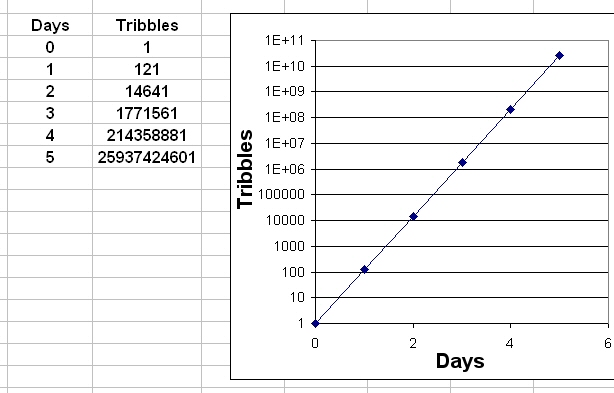
tribbles = 1,771,561 tribbles
For each day, there will be 11t (days)/0.5 days tribbles.
3.
Spock estimates that there would be 1,771,561 tribbles on board (see
above question) after 3 days. Which assumption did Spock use? What actually became of the
tribble population on the Enterprise, and why? 4. What is the doubling time
of the tribble population? The number Nt has to be the same whether the exponential base is 2 or 11. So you can calculate the doubling time (Q=2) from the generation time (Q=11, after 12 hours=0.5 days). N011t
days/0.5 days = N02
t days/d days 111/0.5 = 2 1/d log 112 = log 2 1/d 2 log 11 = (1/d) log 2 d = log2/(2log11) = 0.144 days = 3.47 hours During the poisoning, the
population of tribbles drops to 500 during the poisoning. Assume those
tribbles are still producing 10 offspring per litter, but only half
survive the poison, and the parent dies after one litter. Generation size is now decreased from 11 to 10/2 = 5. log 52 = log 2 1/d d = log2/(2log5) = 0.215 days = 5.17 hours 5.
In an environment like the Enterprise: Nt = N02t days/d days ) Solve for Nt. Assume d=0.144 days [or you may assume d=0.217 days] 109 tribbles = N02(2 days/0.144 days) N0 = 109 tribbles/2(2/0.144) = 65,922 tribbles after 2 days
109 tribbles = N02(t hours/3.47 hours) = 1 x 2(t hours/3.47 hours) Solve for t = total time in hours. log 109 = log 2(t hours/3.47 hours) 9 = (t hours/3.47 hours) x log 2 t hours = 9 x 3.47 hours / log 2 = 104 hours 6. In actual natural environments, what phenomena limit the size of growing populations? In actual environments, population growth is limited by predation of individuals, diseases that kill or decrease fertility, starvation for resources, and overproduction of toxic wastes. 7. If there are 1,200,000
tribbles on the Enterprise and Cyrano Jones takes 12 years to pick them
up: d. Neglecting the time it
takes to store the full bags and get empty bags, how many tribbles could
you pick up in 12 years? Allow yourself some time to eat and sleep. |
** Print all assignments. Handwriting not accepted. **