Test
3 Practice
| 1. How were the dinosaurs related to birds? Which kinds of dinosaurs were most related to modern birds? What kind of evidence supports this and how?
2. Were the dinosaurs warm-blooded or cold-blooded? Cite three different kinds of evidence for warm-blooded, and three different kinds of evidence for cold-blooded. Which kinds of evidence do you consider more convincing?
3. In Jurassic Park, how does Alan Grant use his knowledge of animal physiology to study the dinosaurs and excape them? Cite examples. How does the author (Crichton) use knowledge of modern predators to extrapolate how dinosaurs may have behaved?
4. Explain the processes of obtaining extinct dinosaur DNA; amplification by Polymerase Chain Reaction (PCR); and piecing together chromosomes. What problems occur at each step?
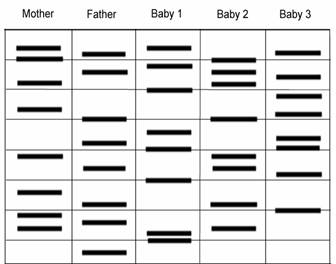
5. Here is a DNA gel from blood samples of two parents and three babies in the hospital.
A. Explain what techniques were used to make this DNA pattern.
B. The following chart shows the appearance of bands of DNA in an electrophoretic gel. Each DNA band is generated by restriction enzymes which cut out DNA fragments of a particular size. The size depends on the length of a multiple-repeated sequence, which varies among individuals. Each individual has two copies (alleles) of this DNA site, which are usually different.
State which baby belongs to the parents, and explain why.
6. How many times would you expect to find a restriction enzyme cut site "CCCATGGG" in a genome of size 7 million base pairs?
7. Explain where the information below would have come from, and what it stands for.
/gene="ptsK" /note="catalyzes the phosphorylation of the phosphocarrier protein HPr of the bacterial phosphotransferase system" /product="HPr kinase/phosphorylase" /translation="MTVTVKMLVQKVKLDVVYATDNLLSKEITTSDISRPGLEMTGYF DYYAPERLQLFGMKEWSYLTQMTSHNRYSVLKEMFKKDTPAVVVSRNLAIPKEMVQAA KEEGISLLSSRVSTSRLAGEMSYFLDASLAERTSVHGVLMDIYGMGVLIQGDSGIGKS AAAMNHRAKEMGFDATKTFEDRLTQLITKNEVSQ"
8. Assuming it were possible to reconstruct dinosaur chromosomes, what would have to be done to recreate the living dinosaur?
9. How could a human be cloned? What technical problems may arise? What moral dilemmas may arise?
10. Explain how embryonic stem cell technology is related to cloning humans.
11. Explain sex-linkage of traits with respect to color vision. Why do most people see three primary colors? Explain how Chrys can see four different primary colors, one of which is seen by no other Valans. What colors do her parents see?
12. Explain the basis of "adaptation" of the senses to stimuli. Why do all our senses "adapt" and become insensitive to stimuli that were detected before?
13. Explain the role of dopamine in signal transmission between neurons, and adaptation to prolonged stimuli. Explain the role of adaptation (or failure to adapt) in addiction. What kinds of stimuli are most strongly addictive?
14. Explain the structure of the arachnoid layer, and its relationship to the rest of the brain. Why do the micros live there?
15. In Brain Plague (p. 317) when Chrys asks her micros whether the newcomers are "false blue angels," they tell her, "Who knows how many true blue angels once were false?" What do they mean? In real life, how is it possible for a "good drug" to also be a "bad drug"? What factors/conditions make the difference? Cite specific examples. How is it possible for "good microbes" to become "bad microbes" and vice versa? Cite specific examples. (Hint: Recall our discussion of microbes and symbiosis or mutualism.)
16. At the end of Brain Plague, why do the micros decide to rebuild the Underworld? Compare and contrast this project with their previous ambitions. How do you think "altruism" relates to the dopamine reward pathway? (Hint: In Sicko, what does Michael Moore say about American culture, right after the hospital dumping scene?)
17. Could machines "evolve" into thinking, feeling beings with “personhood”? Discuss arguments for and against.
18. In Chrys's head (p. 54), the micros reproduce by merging a pair, which then divides into three offspring. The merging and division process takes one hour. What is the micro's doubling time? How many hours will they take for their population to increase by a thousand?
19. In a controlled carrier, the actual growth of a micro population follows an S curve. Why? The midpoint of the S curve (the most dangerous time) has the highest proportion of children, greater than before and after the S curve. Why?
20.
Suppose a population of micros migrates into a new carrier, and the
two carriers stay apart from then on. After 20 days, the DNA sequence
of the two micro populations has diverged by 1%. What is the mutation
rate per day? Why do carriers encourage exchange among micro populations? 21. When Chrys is first examined for the experimental program (p. 27), the doctor asks her if she has any history of addiction. Why? Discuss specific examples of how human genetics and environment together influence: human intelligence; addiction to substances or behaviors; and susceptibility to microbial disease.
22. How does dopamine function in the reward pathway? How does cocaine interact with the reward pathway? In general, how do other substances and behaviors relate to the reward pathway? What aspects of the neural connection determine the addictiveness of a given substance or behavior? |