Back to: Biology 112 Syllabus
Back to: Biology 112: Evolution and Ecology Home Page
Back to: Kenyon College Biology Department
Questions to consider this week: What do we mean by behavior? Why do we study animal behavior,
and why is it adaptive?
Behavior can be defined as "an act or set of acts performed with respect to another animal or the environment"
2. What does it consist of?
- visual signals
- chemical signals (e.g., pheromones; surprize! see how
humans respond to them!)
- auditory signals (sound)
- tactile signals
Ants display many behavioral adaptations: an example is shown below.
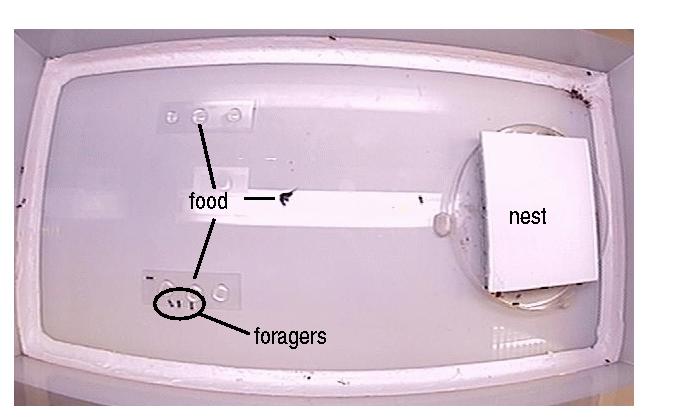
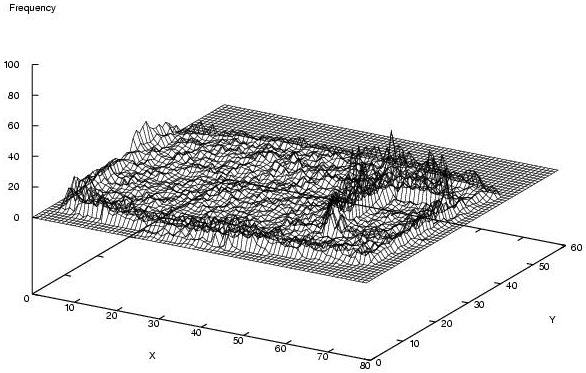
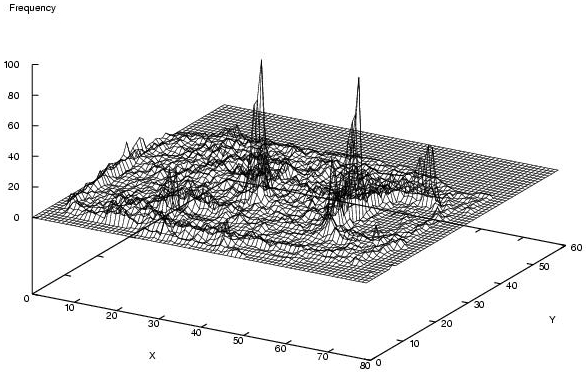
A comparison of spatial activity in an arena with and without the presence of food. Left: Experimental arena. The
colony is housed in a petri dish on the right, three food items are placed on the left. Center: Both graphs depict
the number of visits by ants to each location in the arena over a 30 minute period. The center plot shows foraging
activity with no food present. Right foraging activity with food (from http://www.cc.gatech.edu/~cprl/biotracking/)
How is behavior classified? (what types of behavior are there - think of kangaroos)
- selecting habitat
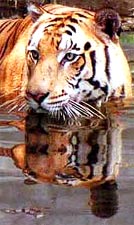
- acquiring food - see Tiger Hunt
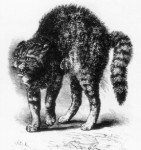
- avoiding threats
- reproduction - more on Tiger's
- care of offspring - and again
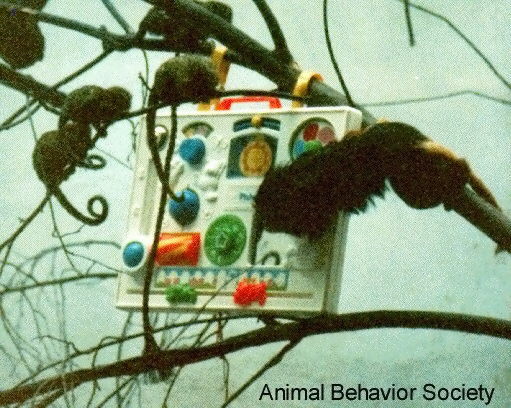
- play/learning
How can behavior be explained?
- the "how" question or the proximate explanation (mechanisms)
- the "why" question or the ultimate explanation (evolutionary explanations)
Social Animals: What are advantages and disadvantages of group living?
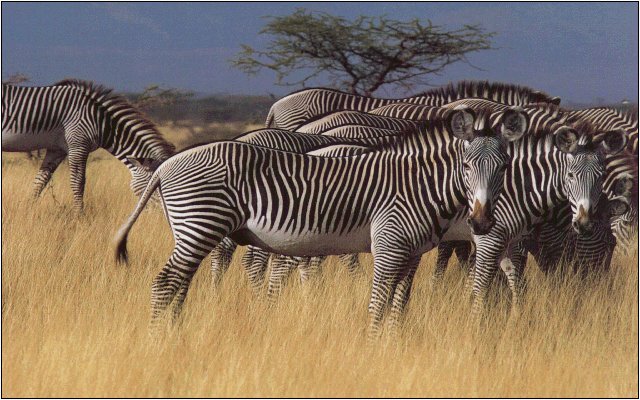
phtot courtesey of: http://www.alumni.caltech.edu/~kantner/zebras/pictures.html
How can we approach this question: the cost-benefit analysis.
Disadvantages (potential costs):
- increased competition
- increased risk of infection
- higher risk that offspring will be killed by other members of the group
- increased risk of being spotted by predators.
Benefits:
- increased ability to detect, repel predators
- higher hunting efficiency (more chances to spot patchy food resources)
- advantages in the potential for division of labor
- conservation of energy
- more likely to find mates
What are the costs and benefits of behavior?
- behaviors are beneficial if successful, but each requires investment (a "cost")
- energy (can only be spent once)
- time (which can't be spent doing other things)
- risk (injury or death may result)
How can we determine if behaviors are adaptive?
- experimental approach
- cost benefit analysis
- behaviors are beneficial if successful
- but each requires investment (a "cost")
- energy (can only be spent once)
- time (which can't be spent doing other things)
- risk (injury or death may result)
- an example using crickets
Altruism vs. Selfishness: how can we explain helpful behavior in light of the "selfish gene"
- the theory of kin selection
- Hamilton's rule
- extreme altruism: the social insects and haplodiploidy
- sterile individuals, or suicidal ones
Reproductive altruism: One individual behaves in such a way as to enhance the reproduction of another individual,
at a cost to its own fitness.
Such altruism is common (or apparently common) in many animals, especially social ones. Examples include:
Alarm calls: Prairie dogs, birds, primates
Queens and workers in social insects
"Aunting" or helping at the nest in some primates and many birds
How can an altruistic behavior be favored by natural selection?
One theory is that of "Group Selection"
But this turns out not to work: altruists are wiped out by cheaters.
As it turns our this is not really altruism becuase the helper is gaining some direct payoff.
Reciprocation
The recipient will return the favor some time, or the helper may gain valuable experience or benefit in some other way at a later time.
These explanations do not cover the full range of altruist behavior, so to explain more fully we have:
Hamilton's Rule (Hamilton 1964):
RB - C > 0
Defines the condition under which a gene causing an altruist behavior will be favored by selection.
This rule is based in part on the idea of "Inclusive Fitness":
The success of a gene is not based solely on what it does for its owner, but on all the effects
it has on all the others who own it as well, weighted by their degree of relatedness.
This not only promotes altruism in some cases; it also places a limit on selfishness.
The rule applies to all effects of the behavior, on self and others.
Hamilton's rule has proved to be one of the most useful concepts in the study of animal behavior.
When you look at all the examples of altruism in nature, they are almost always among relatives,
as predicted by the idea of inclusive fitness.
Applying Hamilton's rule:
Say a gene "programs" the following behavioral rule in organisms that carry it:
"If, when you are still a baby in the nest, you see that another baby in the nest is starving, and
you're not, then let it have some of your food."
In this species, under natural conditions, other babies in your nest are almost never anything but
full siblings (i.e. the females mate only once, and no other females sneak their eggs or young into
other's nests).
Then R=0.5 (full siblings)
As an example, say the food is worth 2 offspring down the road to a starving baby, but only 1
offspring to a healthy baby making the donation.
Why would it be worth different amounts to the two of them?
Because for the starving baby, it might be a matter of life or death, while for the
healthy baby it might just be how comfortable it is until the next meal.
So under our example:
B=2 (value to the recipient)
C=1 (cost to the donor)
Hamilton's rule works out to: 0.5*2 - 1 = 0
So this behavior is neutral. If the benefit were higher, say B=3, the expression would be greater
than zero and the behavior would be favored.
Note that for the gene to spread, we're not talking about the values of B and C in some single
case. The gene's fate would depend on how B and C worked out on average, over all the times
that a starving baby/healthy baby situation arose.
Some common misunderstadings:
The idea: all members of a given species share most of their genes; so Hamilton's rule suggests a general
altruism among all members of the same species.
The truth: relatedness is means similarity beyond the average for the species. Commonly
expressed as "Identity by descent" rather than "Identity by state."
The idea: Hamilton's rule can't work because animals can't be performing complicated pedigree calculations
all the time.
The truth: this is wrong on two counts:
1. The rule states conditions under which the gene will be favored by selection, not a
calculation the animal has to perform. The animal does not have to know its behavior is
adaptive, or why it is adaptive, for selection to work.
2. The rule does not require extremely complex behavioral rules that divide up all resources
proportionate to relatedness (this section thanks to K.F. Goodnight).
Test your knowledge with this Quiz!