Kenyon College Annual Program Report to HHMI, Undergraduate Programs division
Report Period: May 1, 1998 through April 30, 1999
Narrative report on Curriculum, Equipment, and Laboratory Development:
Major equipment purchases were made by the department of Chemistry and the Neuroscience program, while smaller purchases were made by Physics and Math. The department of Biology will make its final equipment purchases from the grant during the summer of 1999.
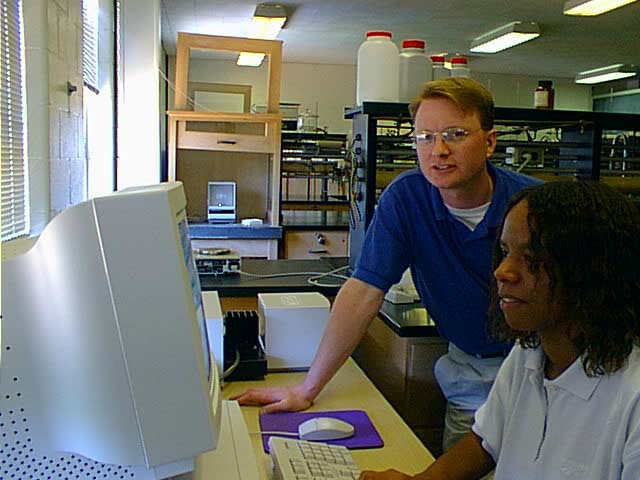
The Chemistry Department purchased a second UV-Vis diode array spectrophotometer, to match the one purchased earlier in the grant's lifetime. The second spectrophotometer adds essential access to a frequently used technique in the redesigned introductory chemistry laboratory course described in Annual reports 1 and 2 (1997 and 1998). With two instruments now up and running in the intro lab, students are able to use the instruments with less wait-time, giving them more time for their other investigations in lab.
Photo 2.1: Kenyon Chemistry major Ndeye Khady Diop, class of 1999 (graduating with high honors in Chemistry), is shown with Assistant Professor Scott Cummings (winner of a 1999 Trustees Award for Teaching), demonstrating the use of the spectrophotometer.
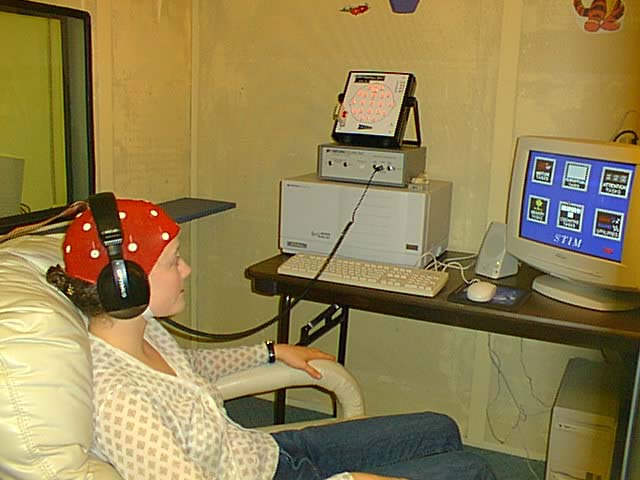
The Neuroscience program has purchased and is installing a Neuroscan EEG/Evoked Potential system. This instrumentation will allow students to collect, visualize, and analyze electroencephalographic and evoked potential data. The instrumentation includes stimulation and scanning software as well as a high-speed amplifier with software control. Stimulation and scanning are each controlled by their own PC-compatible workstation. Both workstations are synchronized to allow recording of evoked potentials to various sensory, cognitive, and neuropsychological tasks. The system is expected to be fully operational by the end of this summer.
Photo 2.2: Kate Norris, class of 1997, visited the department recently and was given a tour of the new apparatus, which recorded her brain wave pattern as she was exposed to visual and auditory stimuli.
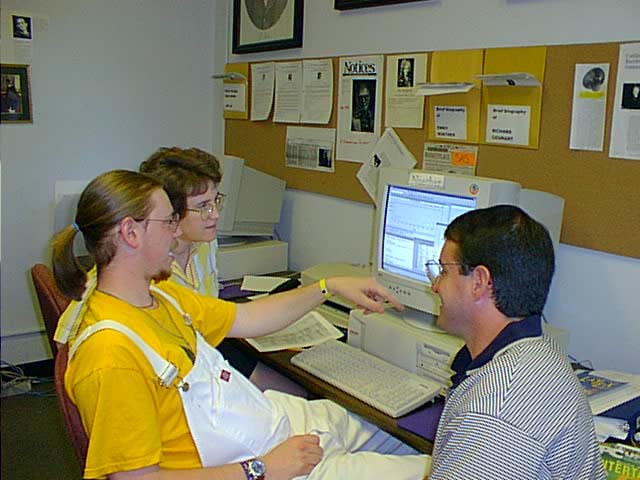
In smaller purchases, the Department of Mathematics acquired a 450 MHz PentiumII workstation and HP LaserJet printer for use by mathematics students undertaking independent projects. A Zip drive and a CD-Writer were added to the workstation, providing backup resources which had been requested by the students. The new equipment, as well as the other workstation and peripheral purchased with funds from this grant, have been heavily used by mathematics students on projects ranging from a study of Bayesian decision theory to the detailed mathematical modeling of the growth of shells by a variety of marine creatures. One student, James Riggs, won a Kenyon award known as the "Franklin Miller Award for Distinguished Accomplishment" for his independent study project entitled, "Consecutive Perfect Numbers or the Lack Thereof." This work made use of the new equipment purchased.
Photo 2.3: Kenyon mathematics major Patrick Schneider, class of 2001, shows Associate Professors of Mathematics Carol Schumacher and Brad Hartlaub the results of the statistical modeling project he completed on the new workstation.
The physics department made a number of small purchases. Three spectrometers and eight permanent magnets were bought for use in introductory laboratories, while optical components and equipment were purchased for use in an independent project on the physics and design of optical tweezers by an advanced physics student.
The spectrometers complete an incremental upgrade of spectroscopic apparatus begun by the department over a decade ago, finally providing eight spectrometers with the same configuration, spectral resolution, and vernier scales. These devices are used to measure the wavelengths of emission lines from hydrogen, helium, and other gases; the new apparatus makes it possible for students to match the known wavelengths of these lines with good accuracy, underscoring the importance of the theoretical framework developed in class to explain and predict the energy levels and transitions in simple atoms. The permanent magnets were used to upgrade an experiment on standing waves produced by induction on a conducting wire. This experiment teaches students the ideas of nodes, antinodes, amplitude, etc. which are crucial to understanding standing waves in situations ranging from ultrasound applications to quantum mechanical wavefunctions. The new magnets, with their stronger, more concentrated field, made it possible for students to collect data for more modes than with previous apparatus.
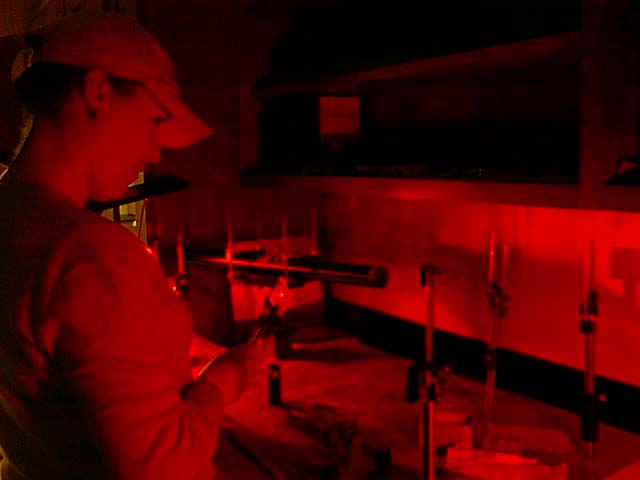
The optical components and equipment shown in the photo below are the beginning of an optical tweezer device, which was the subject of an independent project by Ryan Snyder, class of 1999. Ryan wrote about the physics of the optical tweezer, which uses concentrated light from a tightly focused laser beam to impart momentum to tiny glass or plastic spheres adhered to organelles within cells, moving and manipulating the organelles, for his senior exercise in physics. Ryan, who will be moving on to medical school this fall, hopes to pass his apparatus on to another interested physics major who can pick up where he left off.
Photo 2.4: Kenyon Physics major Laura Glennie, class of 1998, examines the preliminary work of Ryan Snyder, class of 1999, on an optical tweezer device.