Report Period: May 1, 1998 through April 30, 1999
Narrative report on Pre-college and Other Outreach:
Two summer research fellowships for pre-college teachers were funded during the summer of 1998. One project, pursued by Mount Vernon Middle School teacher Bill Ho and supervised by Kenyon Visiting Assistant Professor of Physics and Affiliated Scholar in Biology Eric Holdener, was an investigation of fossils from the Middle Devonian era (approximately 385 million years ago). Ho and Holdener collected a variety of fossils from a deposit of Columbus Limestone located in an active quarry in Delaware County, Ohio. Holdener, a geologist/paleontologist, describes their project: "We collected a variety of corals, many of which were found in growing position. The interesting aspect of the Columbus Limestone at this site is that many of these corals represent an initial recruitment of coral larvae onto a "clean" seafloor. We also collected numerous stromatoporoids, which is a probable sponge, and some of these were over one meter in diameter. Other macrofossils included gastropods, bivalves, brachiopods, rostriconchs (relatives of bivalves), and trilobites. Some specimens were collected in such a manner that the relative order in which recruitment of the seafloor took place might be determined. This part of the investigation is still in progress."
Another project, carried out by Dick Cunningham, biology teacher and head of the science department at Mount Vernon High School (MVHS), involved a variety of agricultural investigations on property surrounding the Kenyon Center for Environmental Studies. Mr. Cunningham worked with Kenyon Visiting Assistant Professor of Biology Oscar Will to take soil samples and do percolation tests on soil along the banks of the Kokosing River, a State Scenic River. The soil samples were tested for nitrogen, phosphorus, potash, and heavy metal levels. The percolation tests involved filling the drill holes from the soil samples with water and measuring the drain time for each hole. These correlated data on soil enrichment and drainage time can be analyzed to build a profile of the agricultural conditions in the area. In addition to the soil studies, they engaged in a study of indigenous North American agriculture, planting and cultivating a Native American garden using seeds with some of the oldest available genomes of corn, beans, and squash. These open-pollinated seeds have been maintained without hybridization (cross-pollination) over thousands of generations by Native American tribes in the Dakotas. They had access to the seeds through Will's connection with tribes still residing in Dakota, through the family seed business established by Will's great-grandfather. Cunningham reports that his experience with the Native American garden was the most useful part of his summer in terms of its impact on his teaching. He hopes to repeat the experience with high school students, and has already begun working with a social studies teacher at MVHS to develop a joint unit on the biology of the plants, the methods for their cultivation, and the societies in which they were first grown and used.
In addition to these summer research opportunities for local science teachers, this grant has enabled Kenyon students and faculty to increase their science outreach activities to area school children. One such project has been the development and implementation of a Kenyon course in which Kenyon science students learn about developing age-appropriate, hands-on lab activities for use in typical middle school science curricula. The projects are developed in collaborations between the Kenyon student, Kenyon faculty members, and a master teacher at the middle school. Each project is then piloted by the student in actual classroom settings at the middle school.
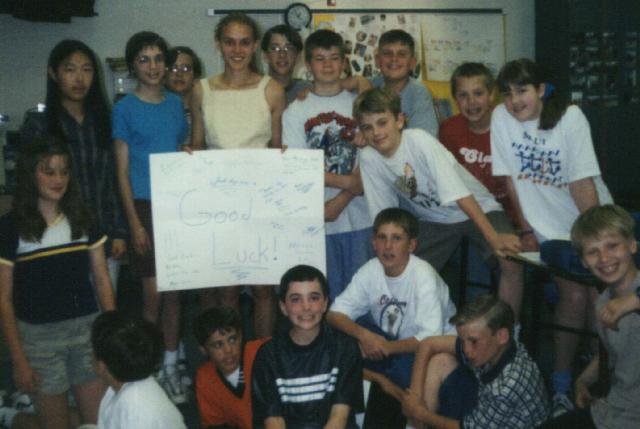
Photo 4.1: Alison Esposito, class of 2000, with some of the Mount Vernon Middle School Sixth Grade Challenge students.
This year, Kenyon psychology major Alison Esposito, class of 2000, developed a series of projects for the Mount Vernon Middle School's Sixth Grade Challenge Class, in collaboration with Mrs. Lori Beach, MVMS Challenge Teacher, and Kenyon professors Dudley Thomas (HHMI Outreach Coordinator) and Paula Turner (HHMI interim program director). Alison worked with the students on survey techniques and statistical analyses. She prepared a teachers' guide which included lesson plans and handout materials for five activities: survey design, sampling and representativeness, scoring and demographics, statistical distributions, and an assessment exercise, in which students were asked to apply the ideas they had learned by designing an experiment of their own. Through this exercise, we were able to assess the extent to which students had learned not only the content material about surveys, bias, sampling, and distributions, but also the extent to which they were able to apply the scientific method in building their proposals.
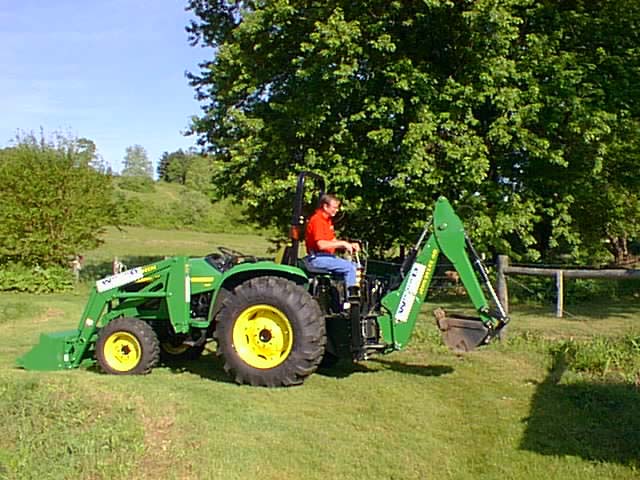
In addition to these activities, we have begun excavation on a set of four experimental ponds on the grounds of the Kenyon Center for Environmental Studies (KCES). These ponds will provide educational opportunities for students of all ages, including area elementary school children, who are frequent visitors to KCES. The ponds will allow the KCES volunteers (mostly Kenyon students, but also some adult volunteers from the area) to prepare long-term projects in controlled still-water ecosystems. These projects will be used for investigations by visiting school classes, with the school children being involved in the collection and study of the marine life in the ponds. Work on the ponds, begun in spring of 1999, will continue throughout the summer.
Photo 4.2: Kenyon College Mechanical Trades Supervisor Jerry Robinson, working on the excavation for the project.