Press Briefing
Supplementary Document
Study of Water Conservation in Deserta Primerta
Report by Lirs Tirtully, Apprentice Planetary Custodian
One of the most fascinating aspects of our beautiful planet of Epicinea, is the variety of life and the ways in which different organisms fill their unique niches. Nowhere is this wonder more apparent than in Deserta Primerta, the largest desert on the planet, which is filled with numerous organisms that have adapted to live in the extreme heat and dryness of desert life. Deserta Primerta receives an average of three inches of rainfall per year and temperatures can reach 125 degrees Fahrenheit. Before I take my place as Planetary Custodian, I felt that it was important that I study the adaptations of organisms of Deserta Primerta.
The most visible animal in Deserta Primerta is the gamret, a gangly flightless bird, which stands high above the hot desert sands on two spindly legs. The height above the sand allows it to escape the most extreme temperatures on the ground surface. Also, the gamret runs across the desert on wide, flat feet to prevent them from burning. A gamret ways around 300 kg and can drink up to 40 liters at a time.
Another organism, the jakram, buries deep around small amounts of groundwater. Jackrams use little water, but because they are clustered around pockets of groundwater, have access to more moisture than other desert organisms. These springs can contain around 80300 liters of water. The jackram, a giant (up to 1 1/2 feet long) annelid lives for years on pockets of water it deep beneath the earth. Each jackram uses ¼ liter of water a day in digestion and other bodily processes. A population of jackrams averages around forty. The following calculation demonstrates how long such population can survive on the water produce by a spring of 80300 L.
¼ L * 40 jackrams=10 Liters/day * 365 days/year= 3650 L/year
80300L/3650L/year= 22 years.
A population of forty jackrams can survive for twenty-years on a spring of 80300L before the population requires that the spring be replenished with rain water.
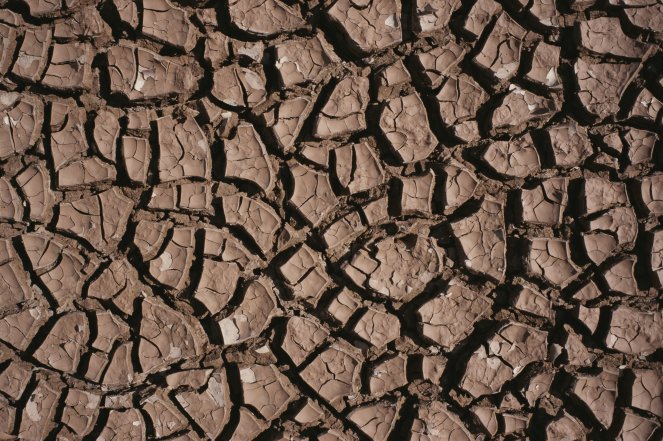
The Deserta Primerta is a vast expanse of dry, cracked earth.
