Press Briefing
Supplementary Document
Acid Rain Damage to Myevgo Lake
Report by Lirs Tirtully, Apprentice Planetary Custodian
The Myevgo Lake in the continent of Trugo has recently begun to experience a downward spiral in life content. The area around the Myevgo Lake is not heavily populated, and so few people have noticed the severity of its damage, but recently the numbers of concerned Epicineans has begun to increase. As I was winding down my day's journey with a contemplative walk around the Myevgo Lake, I ran into an Epicinean fisherman who had come to examine the lake -- the fisherman explained to me that the number of Gibblefish, a popular strain of house fish among young Epicineans, has appeared to have rapidly decreased throughout the past rainy season, causing curious concern among those whose job it is to collect these Gibblefish to sell in the towns. I decided to investigate this environmental change, as it was not only causing concern among the young Epicinean Gibblefish-lovers, but also most likely setting off the lake's predation balance as well.
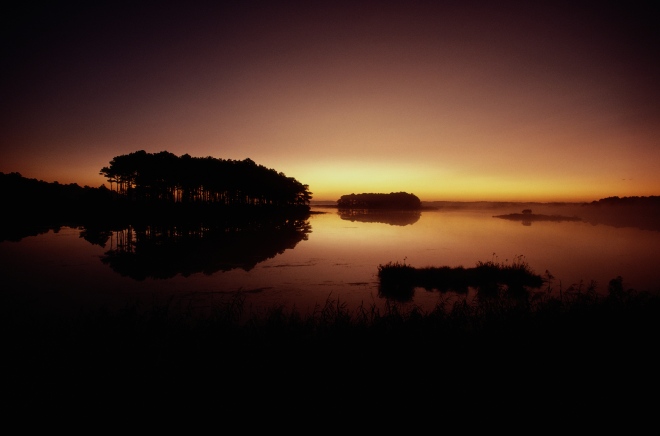
The Secluded Myevgo Lake looks calm and peaceful from the outside while below its waters, prized lifeforms experience disturbing decline.
I suspected that the damage could have emerged from strange occurrences of acid rain in the area surrounding the lake, as the Gibblefish problem began during the rainy season. I decided to take a titration of 1 liter of lake water using a known base of NaOH, by which I found that the lake had an H+ concentration of 3.98 * 10^(-5) moles/liter. Then I found the pH:
pH = -log(3.98 * 10^(-5)) = 4.4
The pH was 4.4 -- certainly acidic. I also knew from past research that acid rain is qualified by having a pH below 5. Thus it was confirmed: the Myevgo Lake had experienced acid rain damage which had disabled Gibblefish eggs from hatching and had finally greatly decreased the lake's population. I did not have time to go into extensive investigation of what other damage had been done to Myevgo's biodiversity, but I did manage to consult with the fisherman who initially informed me of the problem, and told him that acid rain is caused by an excess of sulphur dioxide and nitrogen oxide emissions into the atmosphere which then get absorbed by water droplets in clouds above, finally resulting in acidic precipitation. He noted this information carefully and promised to bring it to scientists in his town who would conduct further experiments to determine what was causing these strange emissions. Luckily for Epicineans, the Myevgo Lake is in a greatly secluded area and the only direct reliance any Epicineans have on the lake is that of Gibblefish collection. That is not to say, however, that the upset balance of lake's biodiversity is not of utmost importance.
