The 2003 HHMI Science/Math Workshop at Kenyon
College
The Howard Hughes Medical Institute (HHMI) Science/Math
workshop is designed to facilitate the transition to college life
for first-generation college students starting at Kenyon.
This is accomplished by introducing the students to the college environment and college-level academics.
At the end of this two week summer program, students are more confident
about enrolling in college and are better prepared to meet future
challenges.
Our experience with this program suggested to us
that some of our approaches to helping these pre-first-year students
would also apply to assisting current students, particularly to develop
math skills. As a result, we drew on our experience to propose a Math
Skills Center as part of our 2004 request to HHMI.
 |
|
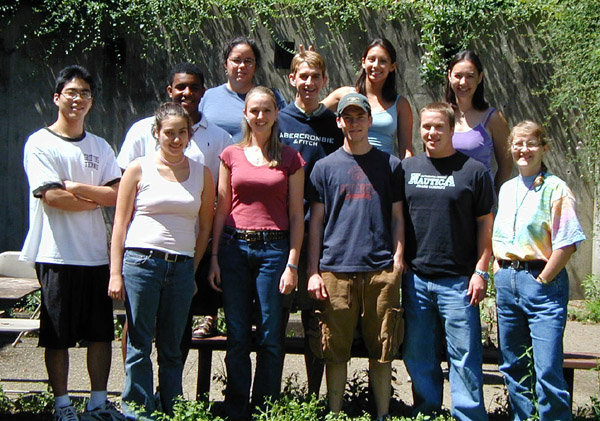
Summer 2003 HHMI Workshop Participants
Front row:
Catherine Curiel, Jenna Rose, Jeffrey Hapiak, Carlin Shoemaker,
Paula Turner (instructor)
Back row:
Back row: Back row:
Bryan Lin, Phillip Waller, Tania Gonzalez (instructor),
Jeffrey Delozier, Porsche Loa Porsche
Loa (resident advisor), Corinne Hirai |
 |
|
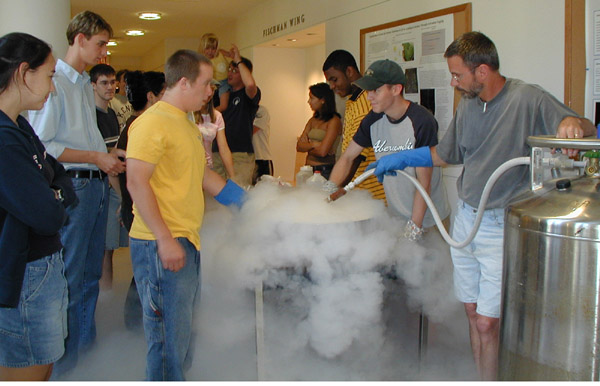
Making ice cream and getting to know Kenyon faculty and
fellow students |
Back
to the top
Academics
The main goal of the HHMI summer program is to acclimate students
to the rigors of college level academics, particularly in the math
and sciences. To this end, students engage in two
college level laboratories, one each in biology
and physics.
During the two week program students are responsible for completing
daily reading
assignments. They are also responsible for two major projects,
a multimedia presentation based on library research of a medicinal
herb, and a formal laboratory report from one of the two labs.
Laboratories
To familiarize students with working in a laboratory, students complete
labs in biology and physics. In both labs students utilize the
skills required in their college lab classes: the ability to follow
a protocol, to accurately generate and record data, to mathematically
manipulate the data with the aid of computer software and to interpret
results. A range of techniques and principles are employed and
students hone their critical thinking skills. One lab is chosen to
write up as a formal laboratory report and includes an abstract, background,
materials and methods, results, discussion and references. This
may be the first such report a student has written. These reports
undergo revision with instructor feedback until they reach the quality
expected in a college science laboratory class. In
fact, many students save their reports to use as an example in future
classes. The successful completion of these labs allows the
students to enroll in their college science lab classes with enhanced
confidence.
Back
to the top
Biology
In the biology lab, students gain hands-on experience formulating
and testing hypotheses, designing sound experiments (including the
use of controls), and applying statistical analyses. The sun produces
tremendous amounts of DNA-damaging UV radiation. Over exposure can
cause skin cancer as mutations accumulate in our genes. Large doses
of UV light can even kill cells. Commonly known as Brewer's or Baker's
yeast, Saccharomyces cerevisiae is easily grown in the lab
and behaves in many ways like human cells. Students investigate the
ability of UV light to kill yeast and then test the ability of sunscreen
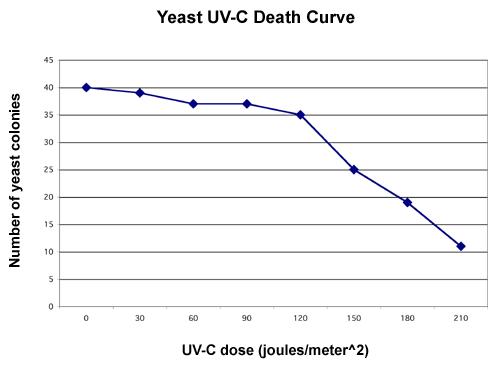
to protect yeast from UV-induced death. Yeast are spread onto nutrient
agar in petri dishes and exposed to varying amounts of UV-C light
(254 nm) to determine the UV-C dose that results in 90% cell death.
In the second experiment, the ability of different sunscreens to
protect yeast from UV-C induced death is measured. Here, 1.5 grams
of sunscreen is spread between two sheets of plastic wrap and then
placed between the yeast and the UV-C source. The cells are exposed
to a dose of UV-C that, based on the first experiment, students calculate
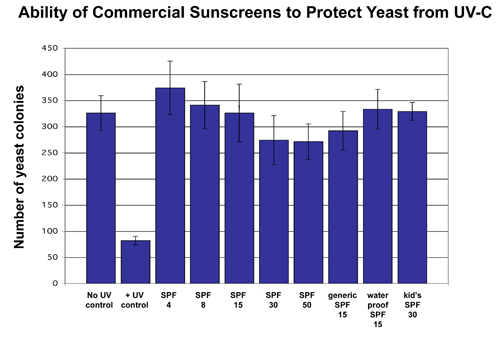
should result in 90% cell death. Students compare Brand X sunscreen
with SPF (Sun Protective Factor) values ranging from 4 to 50. They
also compare generic, water-proof, and children's sunscreen formulas.
The program Excel is used to statistically and graphically analyze
their data. This summer, we hypothesized that high SPF values would
correlate with high UV-C protection. The data showed a trend opposite
to that predicted (see below). Protection against UV-C exposure increased
with decreasing SPF values. Students investigated and found that the
chemicals used in sunscreen are not designed to absorb (and thus block)
UV-C. Instead, they are made to absorb most UV-B (280-315 nm) and
some UV-A (315-400 nm) light. This makes sense as Earth's atmosphere
absorbs 100% UV-C, and most UV-B, but no UV-A.
Back
to the top
Physics
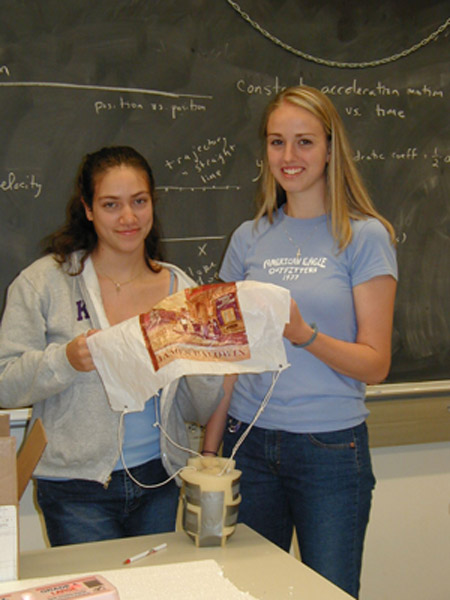
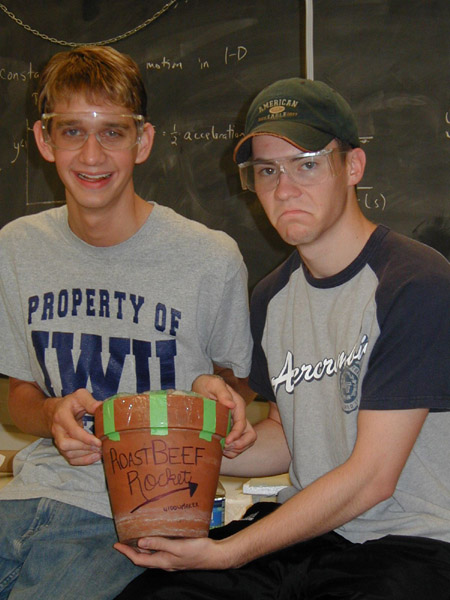
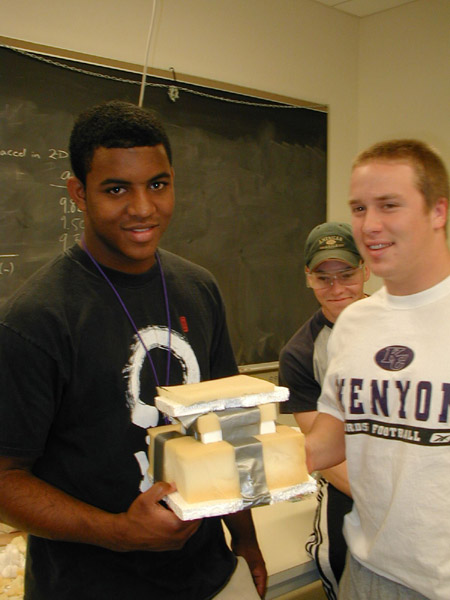
In the physics lab students learn about force, velocity, momentum,
and impulse by engaging in an egg-drop contest. They work in teams
of two to design and build an apparatus that will keep a raw egg from
breaking when dropped from a height of about 20 meters onto concrete.
Students examine the stategies behind their designs in light of the
physics of impacts, articulating how they expect to decrease the force
on the egg. Generally, designs combine features from two categories
- ones that reduce the impact speed ("parachute effect") and ones
that increase the duration of the collision. In order to quantify
their success (since most of the eggs do indeed land unbroken), students
record each drop on video tape, using standard video motion analysis
techniques taught in introductory college physics lab courses to measure
the impact velocities of their egg drop apparatuses.
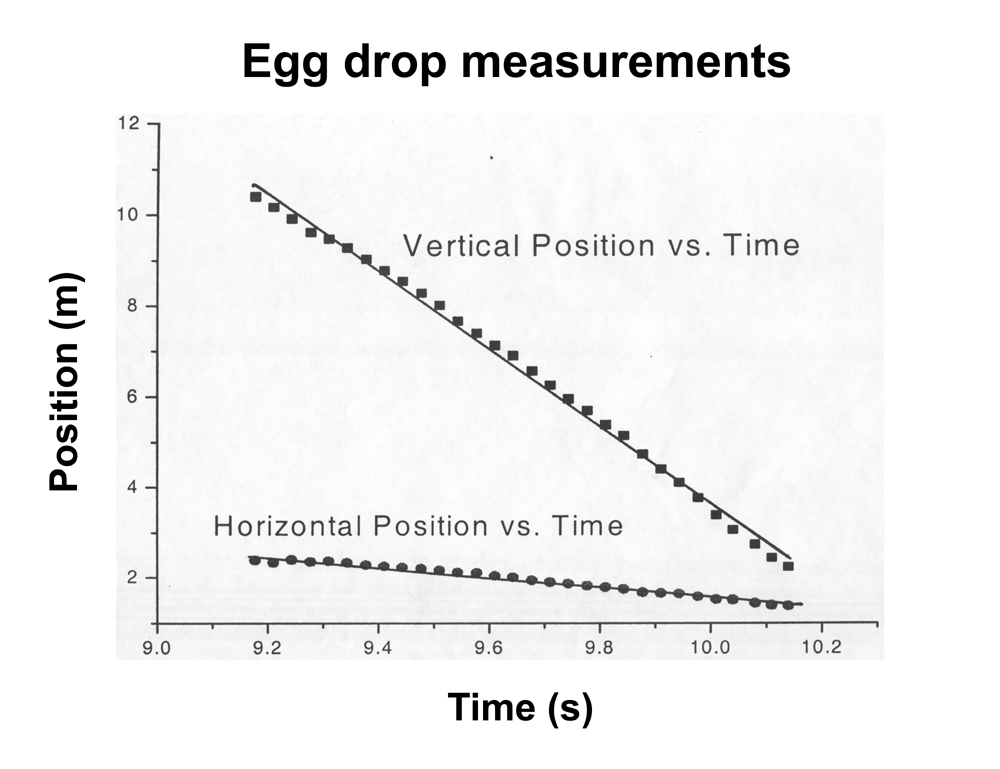
The above graph shows a typical data run, with points marking the
horizontal and vertical position of the apparatus in successive video
frames. The slopes of the lines are combined using the Pythagorean
Theorem to give the final velocity, 8.7 +/- 0.1 m/s. Bragging rights
go to the team whose egg dropped with the fastest impact velocity,
landing unbroken. In this lab, students became familiar with basic
physics principles such as force and velocity and learned a versatile
video technique for measuring velocities accurately. They also learned
about measuring experimental uncertainty, using a computer data fitting
program, and producing properly labeled graphs.
Back
to the top
Readings
Students and professors also meet to discuss various scientific topics
based on assigned readings. Some of these reading stretch
the limits of the students understanding, and the students learn how
to formulate questions. Due to student interest, these discussions
often become informal debates about current scientific issues affecting
society such as cloning, cosmic origins and globalwarming. Students
gain an appreciation for the fact that scientific knowledge is not
static but evolves. Additionally, they discover that scientific
research can impact society and thus is a worthwhile pursuit.
Presentations
| Photo credit P. Heithaus |
 |
|
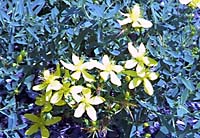
St. John's wort (Hypericum perforatum) |
The highlight of the program are multi-media presentations on one
of the medicinal plants found at the Brown Family Environmental Center
at Kenyon College. Working in groups, students engage in library
research of their chosen plant using book, journal and web-based sources.
Using Microsoft PowerPoint, they create visually stunning presentations
that they orally present to the entire group (each group member must
speak during the presentation). Not only do students learn how
to find information, for some students it was their public speaking
debut. Students truly enjoyed putting their presentations together
and were justifiably proud of the results.
Back
to the top |