
 AUXINABCISIC ACIDGIBBERELLINSCYTOKININSETHYLENE to learn more about each hormone
These are a few hormones that are believed to be involved in an enormous variety of responses. This document is in no way able to gather all research available on the signaling pathways of these hormones. It is my goal to present the research regarding receptor protiens involved with these homones. Much intresting research is available on how these receptor protiens amplify the hormonal signal by intervening in regular cellular processes. Plant hormones are present in micromolar or submicromolar concentrations therefore it is essential in the hormone signal pathway that the hormone signal be amplified for a response to occur. This signal amplification may occur by a number of mechanisms, one of which is the controll of gene activity.
POSSIBLE SITES OF SIGNAL INTERVENTION 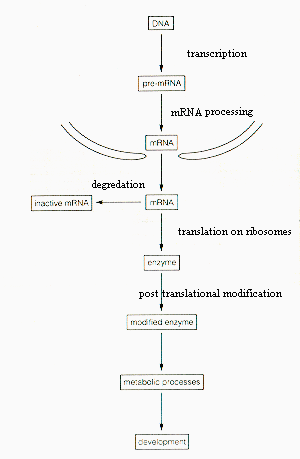 Figure 1. Possible sites of homonal control of gene activity. We can see that activation of genes represents a method of amplification that can lead to many copies of an important cellular product. Various control points in the flow of genetic information from DNA to a molecular product can be seen in figure 1. These processing steps are controlled by enzymes whose actions might be regulated by hormones.
The low concentrations of hormones in plants require more than just the amplification of the signal. There are three main parts of a response system:
1**THE HORMONE MUST BE PRESENT IN SUFFICIENT QUANTITY IN THE PROPER CELLS.
2**THE HOMONE MUST BE RECONGNIZED AND BOUND TIGHTLY BY EACH OF THE GROUPS OF CELLS THAT RESPOND TO THE HORMONE (TARGET CELLS)
3**THE RECEPTOR PROTIEN MUST CAUSE SOME METABOLIC CHANGE THAT LEADS TO AMPLIFICATION OF THE HORMONAL SIGNAL.
The mechanism through which the hormone is able to confer information to plant cells is not well understood. Animal researchers are familiar with a signaling pathway involving inositol tri-phosphate that may be present in plants. This pathway would explain many hormonal signals that appear be involved with phosphoralation and dephosphorylation activity.
THE INOSITOL TRI-PHOSPHATE SIGNALING PATHWAY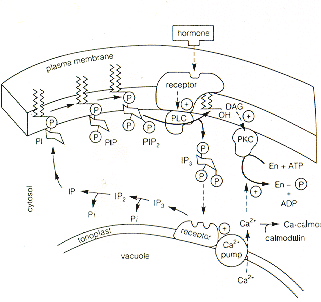 Figure 2. Model for initial hormone transduction at the plasma membrane. Binding of a hormone to its receptor causes activation (+) of nearby phospholipase c (PLC). PLC hydrolyzes a membrane lipid, phosphatidylinositol-4,5-bisphosphate (PIP2) to release inositol-1,4,5-triphosphate (IP 3)and a diacylglycerol (DAG). IP3 moves to the tonoplast in plant cells, where it combines with a receptor that activates (+) a CA